BauTV+ NewsBlog
Digitalisation in the construction industry: What is changing
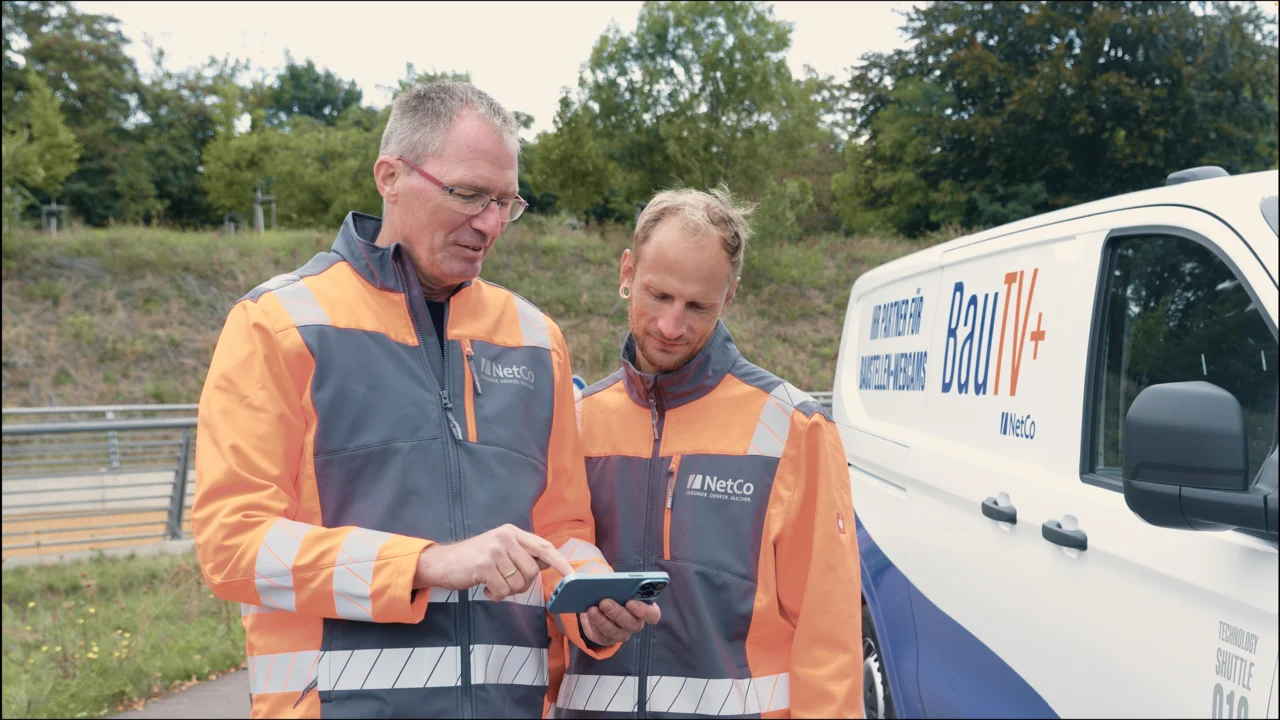
The construction industry is at a turning point. Whilst other industries have long been operating digitally, the construction sector often still lags behind. However, a significant shift is currently on the horizon. New technologies such as BIM, AI and digital construction site documentation are fundamentally changing work processes. This article outlines the current state of digitalisation, which potential remains untapped and how construction companies can benefit from this transformation.
What does digitalisation actually mean in the construction industry?
Digitalisation in the construction industry describes the process of replacing or supplementing analogue processes with digital technologies. This is not just about the use of individual apps or software, but a fundamental transformation of the entire value chain. From planning through construction to handover: every step can be optimised through digital solutions.
In the construction sector, digitalisation is particularly complex because many different trades, companies and skilled workers have to work together. Digital solutions create transparency here and improve communication between those involved. Standardised interfaces and networked systems enable a smooth exchange of data that used to take days or weeks.
Specifically, digitalisation in construction encompasses areas such as Building Information Modelling (BIM), digital site documentation and monitoring using camera systems and web portals, cloud-based project management tools, automated processes in construction, and the use of drones or sensors. Providers such as NetCo have specialised in these digital tools and offer full-service solutions that make it easier to get started with digitalisation.
Table of Contents
What is the current state of digitalisation in the construction industry?
The state of digitalisation in the construction industry has improved significantly in recent years, albeit from a low base. According to a study by PWC, many respondents still see considerable untapped potential. Whilst large construction firms are already working digitally, smaller businesses often still struggle with the transition.
The PWC 2025 study shows that around two-thirds of respondents consider digitalisation to be important or very important for their competitiveness. At the same time, many state that a lack of expertise and bureaucratic hurdles are the biggest obstacles. The digital infrastructure on construction sites is often still inadequate, which makes it difficult to use digital tools. Increasing cost pressures also present an additional hurdle to investment in new technologies.
of construction companies lack the knowledge to
exploit the potential of digitalisation
0 %
of construction companies are feeling
increasing cost pressure
0 %
The gap between aspiration and reality is particularly striking when it comes to specific technologies. According to the PWC study, 68 per cent of respondents see great potential in real-time reporting, yet only 21 per cent possess the relevant capabilities. The gap is even more drastic when it comes to AI-based technologies: 66 per cent recognise the potential, but only 9 per cent can utilise it. The situation is similar for IoT solutions on construction sites, where 62 per cent see potential, yet only 10 per cent possess the necessary skills. Cloud technologies and platforms are rated as promising by 81 per cent, whilst only 38 per cent have sufficient capabilities.
Yet it is precisely in these areas that plug-and-play solutions such as BauTV+ from NetCo are already available: the web-based cloud portal provides real-time reporting via live images and automated AI daily construction reports. The integrated AI activity detection and event tagging assist with digitalisation without companies having to build up their own expertise. As an IoT solution on the construction site, the cameras continuously capture data and link it to site-specific weather data. The key advantage: as a full-service provider, NetCo takes care of consultancy, installation, operation and support entirely. This means that even the 82 per cent of companies without in-depth digitalisation expertise can immediately benefit from the potential they have long recognised.
Demand for digital solutions is rising steadily. Digital solutions are increasingly being made a prerequisite in tendering processes, which is increasing the pressure on construction companies to digitise their processes. The industry recognises that Construction 4.0 is no longer a trend, but a necessity.
Source: PwC (2025): The challenges facing the German construction industry in 2025. Available online at: https://www.pwc.de/de/risk-regulatory/risk/capital-projects-and-infrastructure/bauindustrie-unter-druck.html
What potential does digital transformation offer construction companies?
The potential of digitalisation in the construction industry is enormous. Several studies demonstrate the efficiency gains achieved through digitalisation in the construction sector: The Fraunhofer study shows that digital platforms and integrated processes improve collaboration and make projects faster and less error-prone (Fraunhofer IESE & DiCoMa, 2023). Capmo’s Construction Efficiency Study, based on around 40,000 digitally recorded projects, demonstrates that digital tools create transparency and enable measurable productivity gains (Capmo, 2022). Furthermore, a scientific literature review confirms that digital technologies such as BIM and automated workflows reduce costs, improve quality and enable construction projects to be managed more efficiently (Emerald Insight, 2021).
A key benefit lies in the reduction of rework. Digital planning tools and BIM enable collisions and errors to be identified before construction even begins. This saves not only time, but also material and labour costs. At the same time, digital documentation allows for seamless tracking of all work stages, which is crucial for warranty issues and quality assurance.
Communication also benefits: when all project stakeholders access the same digital data, there are fewer misunderstandings. The visualisation of construction projects through 3D models, live streams, live images and videos facilitates coordination with clients and investors. Public presentation can also benefit from transparent live streams and spectacular time-lapse films. NetCo’s BauTV+ web portal enables precisely this: project managers can view construction progress at any time and from anywhere, and the public can also participate in specific project phases if desired. With over 10,000 successfully documented projects and 25 years of experience, NetCo demonstrates how digitalisation works in practice.
BIM (Building Information Modelling): The digital backbone of construction
Building Information Modelling, or BIM for short, is regarded as a key technology for the digitalisation of the construction industry. It is a method in which all relevant data relating to a building is consolidated into a digital model. This model accompanies the construction project throughout its entire lifecycle, from initial planning to demolition.
The advantage of BIM lies in centralised data management. All parties involved – architects, engineers, construction companies and clients – work with the same information. Changes are automatically synchronised, and clashes between different trades are identified at an early stage. This reduces planning errors and significantly speeds up the progress of construction projects.
The combination of BIM and other digital tools opens up additional possibilities. Digital twins – virtual representations of real buildings – enable simulations and optimisations before the first sod is turned. In public procurement processes, BIM is now often mandatory.
Which technologies are driving digitalisation in the construction industry?
In addition to BIM, there are numerous other technologies transforming the construction industry. An overview of the most important ones:
- BIM: Centralised data management for all project stakeholders throughout the entire lifecycle of a building
- Artificial Intelligence and Machine Learning: Analysis of large data sets, more precise cost estimates, prediction of construction delays
- Internet of Things (IoT): Networked construction machinery, sensors for temperature, humidity and vibrations, automatic maintenance alerts
- Big Data: Analysis of project data for process optimisation and pattern recognition
- 3D printing: Manufacturing of building components or entire structures directly on site
- Virtual Reality: Immersive virtual tours of buildings during the planning phase for coordination with clients
- Drones: Aerial photography for surveying, documentation and marketing
- Digital site documentation: Webcams, web portals and apps for comprehensive progress documentation
The use of artificial intelligence enables, for example, more precise cost estimates or the prediction of construction delays. The Internet of Things connects machines, devices and sensors on the construction site. Connected construction machinery automatically reports its location and maintenance requirements. This data feeds into big data analyses and helps to optimise processes. All the technologies mentioned, such as artificial intelligence, IoT and 3D printing, will continue to transform the construction industry in the coming years.
How do construction sites benefit from digital documentation using web portals?
The construction site is where digitalisation is particularly noticeable. Digital tools replace paper lists, manual logs and time-consuming inspection rounds. Instead, site cameras automatically document progress and save images at regular intervals. GDPR-compliant solutions such as BauTV+ from NetCo automatically blur out people, thereby ensuring data protection without manual effort.
Modern construction site management relies on web-based portals that allow access from anywhere. An overview of the key features of BauTV+:
- Live access: Track construction progress in real time, from the office, on the move or at home
- Automated time-lapse: Individually configurable by time period, speed and resolution
- AI-powered activity detection: Automatic detection of vehicle and pedestrian movements
- Event tagging: Automatic categorisation of key events such as material deliveries or milestones
- Dynamic GDPR pixelation: People and sensitive areas are detected and pixelated in real time
- Integrated daily construction report: Export weather data, activities and events at the click of a button
- Online weather station: Site weather data accurate to within 100 metres
- Image archive: All recordings sorted by date and time for seamless tracking
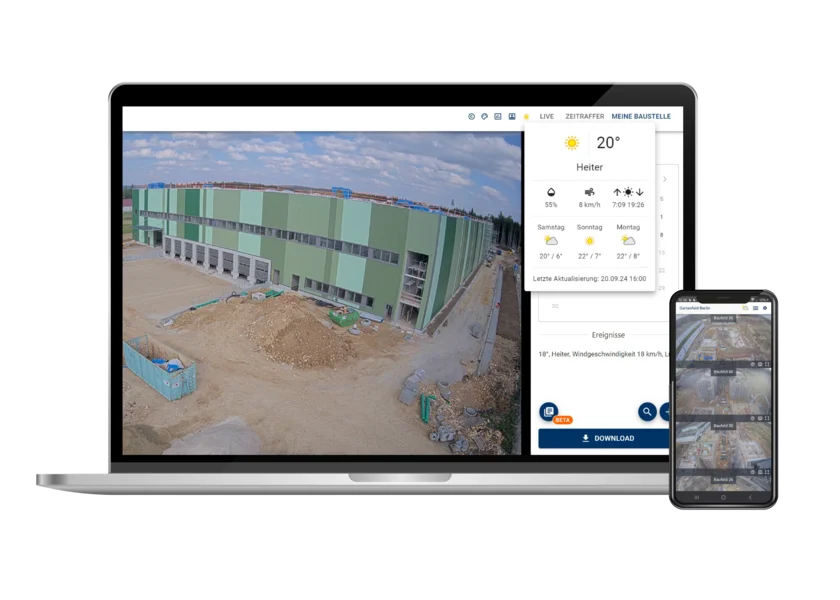
With BauTV+, site managers, clients and project managers can monitor construction progress live. This saves time and travel costs. Saving just one inspection trip per week can already cover the monthly cost of a construction site camera. At the same time, the archived footage serves as evidence in the event of disputes or warranty issues.
The BauTV+ app also makes the construction site mobile: Push notifications alert users to important events, time-lapse videos can be viewed directly on a smartphone, and all construction documentation is always at your fingertips. NetCo is currently the only provider in Germany offering such a comprehensive app for construction site documentation. For project managers, this means faster decisions based on up-to-date data.
How does AI support construction site documentation?
AI-powered features take construction site documentation to a new level. Automatic activity detection captures and analyses vehicle and pedestrian movements on site. This gives project managers an overview of actual activity without having to be there in person. The analysis is GDPR-compliant, as people and vehicles are automatically pixelated.
BauTV+’s event tagging automatically categorises important events. Users define relevant milestones once, such as “earthworks commence” or “material delivery”, and the AI recognises these events in the camera images. This saves time on manual documentation and ensures that important progress is not overlooked.
The integrated daily construction report summarises weather data, activities and events and can be exported with a single click. It will soon be expanded to include AI-generated construction progress reports based on image analysis. For project managers, clients and investors, this means greater transparency and a solid data foundation for decision-making.
Automated construction log
Automated project summary
What obstacles are slowing down the digitalisation of the construction industry?
Despite all the progress, there are obstacles that are slowing down digitalisation in the construction industry. The biggest hurdles, according to the PWC 2025 study:
- Lack of expertise: Many skilled workers are unfamiliar with new technologies; training costs time and money
- Bureaucratic hurdles: Complicated approval procedures, inconsistent standards and a lack of legal frameworks
- Inadequate digital infrastructure: Without a stable internet connection, cloud solutions and real-time documentation do not function reliably
- Investment costs: New software, hardware and training require capital that smaller businesses in particular often cannot afford
- Resistance to change: Older employees in particular struggle with the transition to digital processes
This is where full-service providers such as NetCo come in: With flexible rental and purchase models, self-sufficient camera solutions powered by solar energy and LTE connectivity, as well as German-language support, the barriers to entry are significantly lowered. The NetCo team can handle installation on request, so no in-house technical expertise is required. The basic tariff starts from just €195.95 per month, which is often cheaper than a single site inspection visit.
How can construction companies drive digitalisation within their organisation?
Driving digitalisation within your organisation requires a clear strategy. Start by taking stock:
- Which processes are already digital?
- Where are there media breaks?
- Which workflows can be automated?
The answers will show where the greatest need for action lies.
Opt for standardised solutions that have proven their worth. Instead of launching complex in-house developments, use established tools for project management, documentation and communication. Look for established providers offering everything from a single source: development, hosting and support from Germany, such as NetCo BauTV+. This means short communication channels, fast response times and fewer headaches thanks to a dedicated contact person.
Invest in your skilled workforce: training and further education build expertise and reduce resistance. Involve your staff at an early stage and demonstrate the concrete benefits of digital tools. If the site manager sees that he saves three hours’ travel time per week by using the app for construction documentation, he will quickly accept the solution. Digital transformation can only succeed if everyone involved is on board.
Conclusion: The future of Construction 4.0 is digital
The digitalisation of the construction industry is advancing. Trends and technologies such as BIM, AI and digital site documentation are fundamentally changing work processes. Those who invest now secure competitive advantages. Those who hesitate risk falling behind.
The potential is enormous: more efficient processes, fewer errors, better communication and greater transparency. At the same time, there are hurdles such as a lack of expertise, bureaucratic obstacles and investment costs. Yet these hurdles can be overcome if construction companies take a systematic approach and rely on proven solutions. Full-service providers such as NetCo make getting started easy: flexible models, robust technology, German data security and personal support.
In the construction industry, digitalisation is now unstoppable. The question is not whether, but how quickly companies will implement the transformation. With the right tools, partners and a clear strategy, the challenge becomes an opportunity. Everyone benefits from a future-proof construction industry and more efficient construction projects – from the site manager and the tradespeople on site right through to the customers.